How Walmart Built a Stepladder/ Off Government Assistance, not into it...

PEN TO POWER | Accountability in Journalism
Walmart wages and how the left “lied again”
Walmart does not create welfare recipients
By Moon Geezer | Pen to Power | May 2026
SECTION I: THE ACCUSATION VS. THE ARITHMETIC
"The political narrative is familiar: Walmart, the largest private employer in the United States, pays wages so low that its workforce is forced onto government assistance, effectively offloading the true cost of its labor onto American taxpayers. The charge has a dollar figure attached to it: $6.2 billion in annual public assistance costs. That number originated in a 2014 report by Americans for Tax Fairness, itself extrapolated from a 2013 Democratic House staff study of a single Walmart Supercenter in Wisconsin. Americans for Tax Fairness took the midpoint cost per worker from that one store and multiplied it across Walmart's 1.4 million employees to produce a national estimate. It was never a measured audit. It was arithmetic built on one building in one state, and it has circulated unrevised for more than a decade as though it were something more rigorous than that. Six years after that figure was coined, Senator Bernie Sanders commissioned the Government Accountability Office to conduct a more serious examination. The question Pen to Power asked is whether either study, taken alone, tells an honest story."
It does not.
Walmart’s fiscal year 2025 Annual Report records total revenues of $681.0 billion and net sales of $674.5 billion. The company employs approximately 2.1 million associates worldwide, with roughly 1.6 million in the United States. Net income for the year was $19.44 billion. Revenue per U.S. employee stands at approximately $324,280. Those numbers establish the scale of the enterprise that critics hold responsible for a welfare dependency crisis. The arithmetic beneath that accusation, examined carefully, points in a very different direction.
“If not for the employment access Walmart and other companies provide, many more people would be dependent on government assistance.” — Walmart spokesperson, November 2020
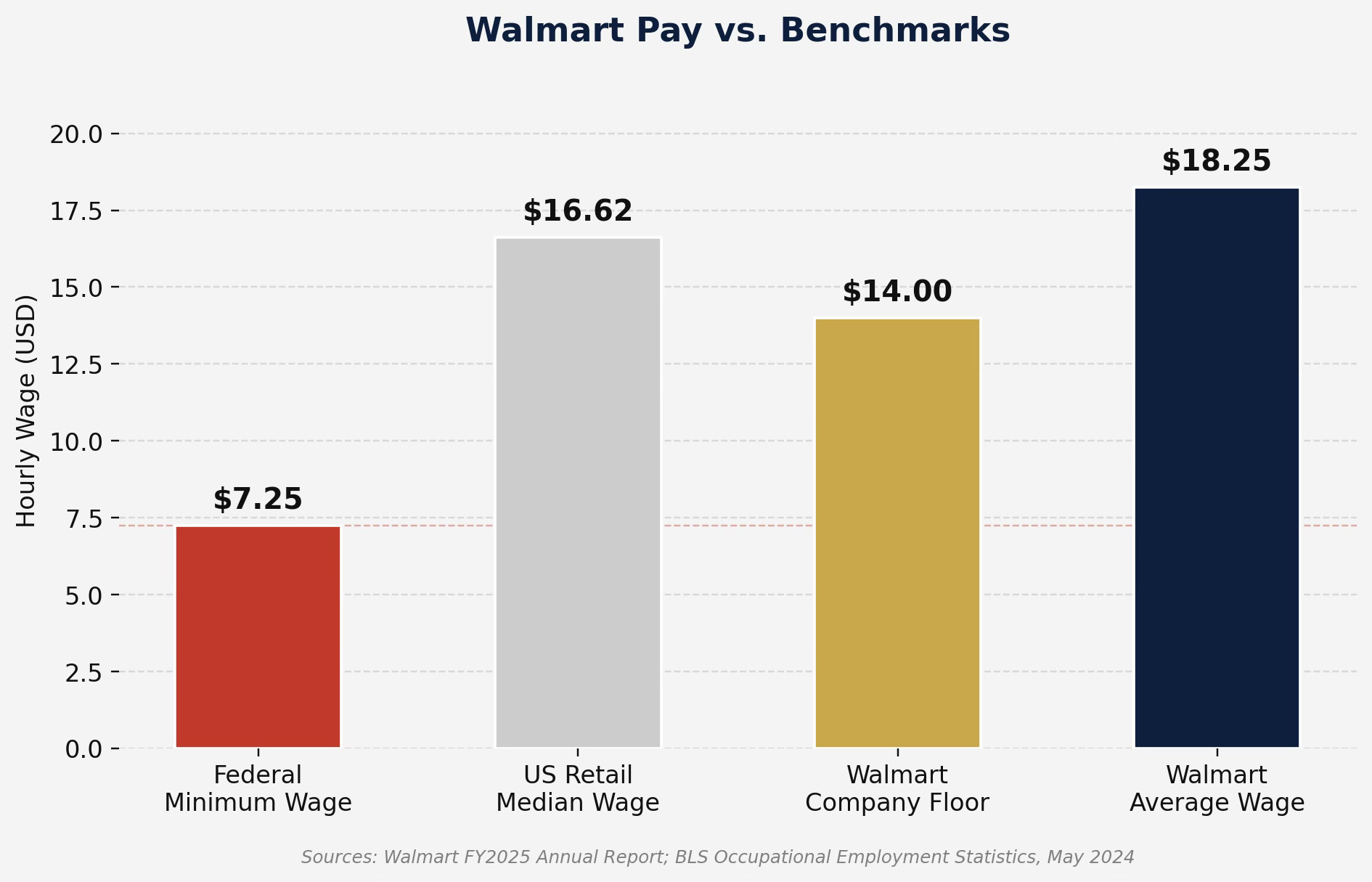
The federal minimum wage has remained fixed at $7.25 per hour since 2009. The Bureau of Labor Statistics reports that the national median hourly wage for retail salespersons was $16.62 in May 2024, with the lowest ten percent of the industry earning less than $12.31 per hour. Walmart’s company-wide floor is $14.00 per hour nationally, rising to $17.00 or higher in high-cost states. The company’s average U.S. associate wage reached $18.25 per hour in fiscal year 2025. Every one of those figures sits above the federal minimum. Most sit above the industry median.
SECTION II: A DECADE OF CLIMBING
Since 2015, when Walmart announced a landmark three-year, $2.7 billion investment in its workforce, the company’s starting wage has increased by more than 103 percent. That trajectory did not coincide with a period of stagnation in the broader retail market. It exceeded it, consistently, for ten consecutive years.
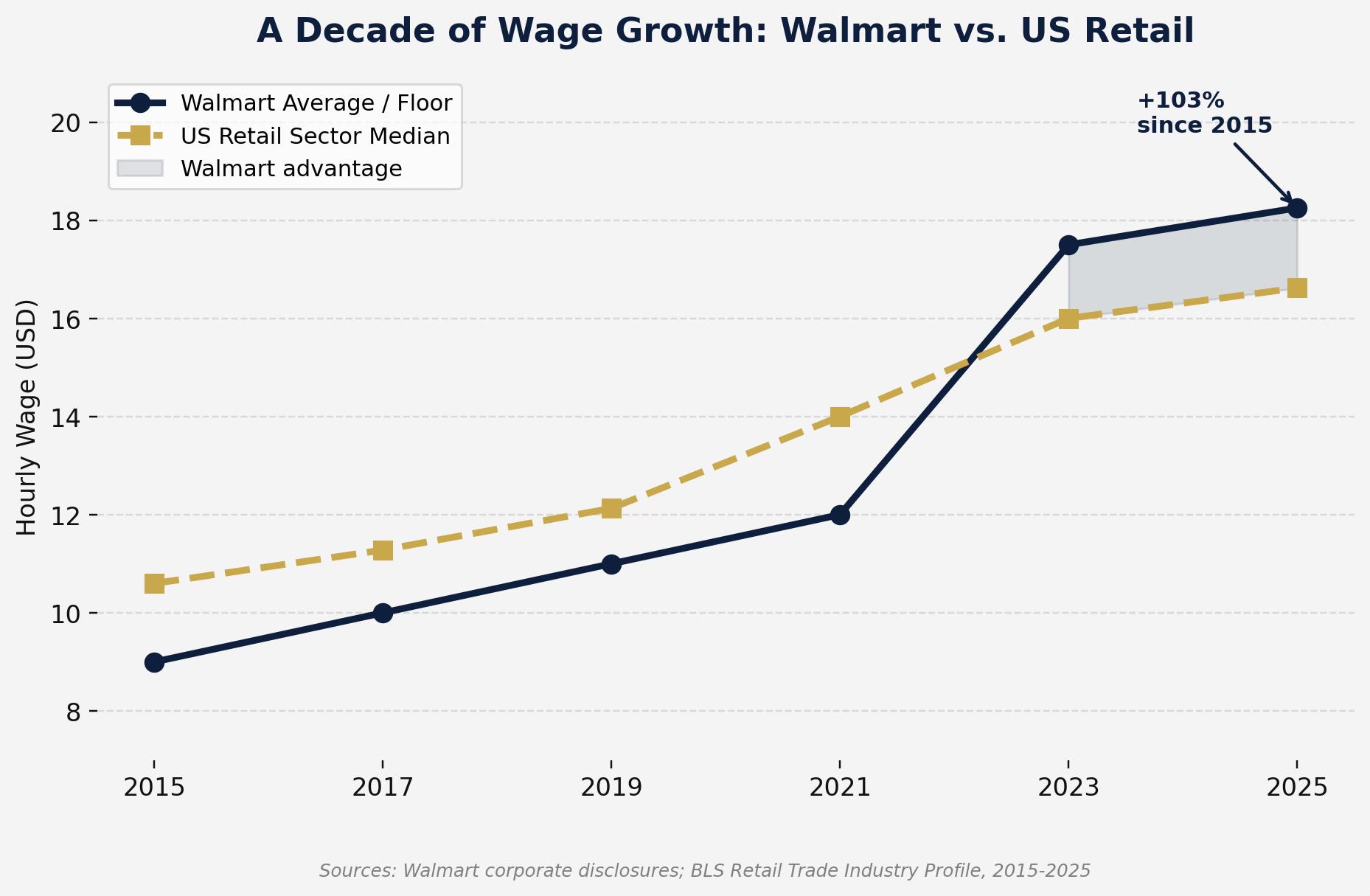
In 2015, Walmart’s starting wage was $9.00 per hour against a retail sector median of approximately $10.60. By 2025, Walmart’s average associate wage of $18.25 exceeds the national retail median of $16.62 by $1.63 per hour. In a sector where sub-$15 wages are the norm rather than the exception, that gap is meaningful. The company introduced performance-based raises of up to 5 percent annually for more than 500,000 hourly workers, launched the Live Better U tuition-free college degree program, and built an Associate-to-Driver certification track paying up to $110,000 per year.
SECTION III: THE SUB-$15 PICTURE
The Bureau of Labor Statistics published a detailed Spotlight on Statistics report in 2024 examining the universe of workers earning less than $15 per hour. The findings reframe the Walmart conversation entirely.
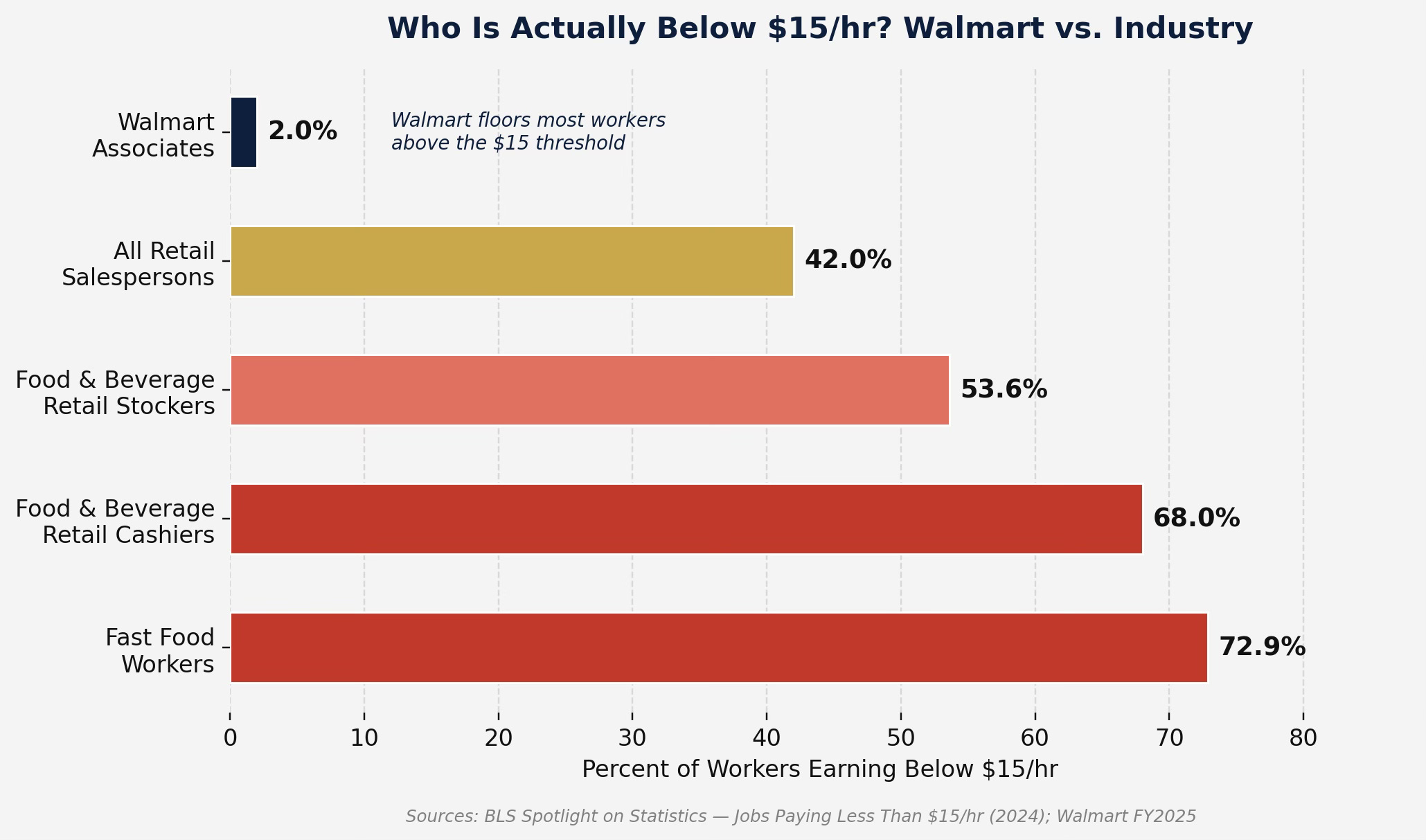
In the food and beverage retail sector, 68 percent of cashiers and 53.6 percent of stockers and order fillers earn less than $15 per hour. Among fast food and counter workers, that figure rises to 72.9 percent. Walmart’s estimated share of associates earning below $15, given a company floor of $14 and an average of $18.25, is below 2 percent. This is the industry context that the $6.2 billion figure strips away.
SECTION IV: THE GAO DATA — WHAT IT ACTUALLY SHOWS
The 2020 Government Accountability Office report is the primary source for the claim that Walmart is a top employer of SNAP and Medicaid recipients. Across every state that provided data, the percentage of working adult Medicaid enrollees and SNAP recipients employed by any single employer did not exceed 4 percent. The raw numbers from those nine states: approximately 14,500 Walmart workers were enrolled in SNAP and approximately 10,350 were on Medicaid. Against Walmart’s U.S. workforce of roughly 1.6 million, those figures represent less than 1 percent of the company’s American employees. The GAO itself stated that its data was not nationally generalizable and represented a single point in time.
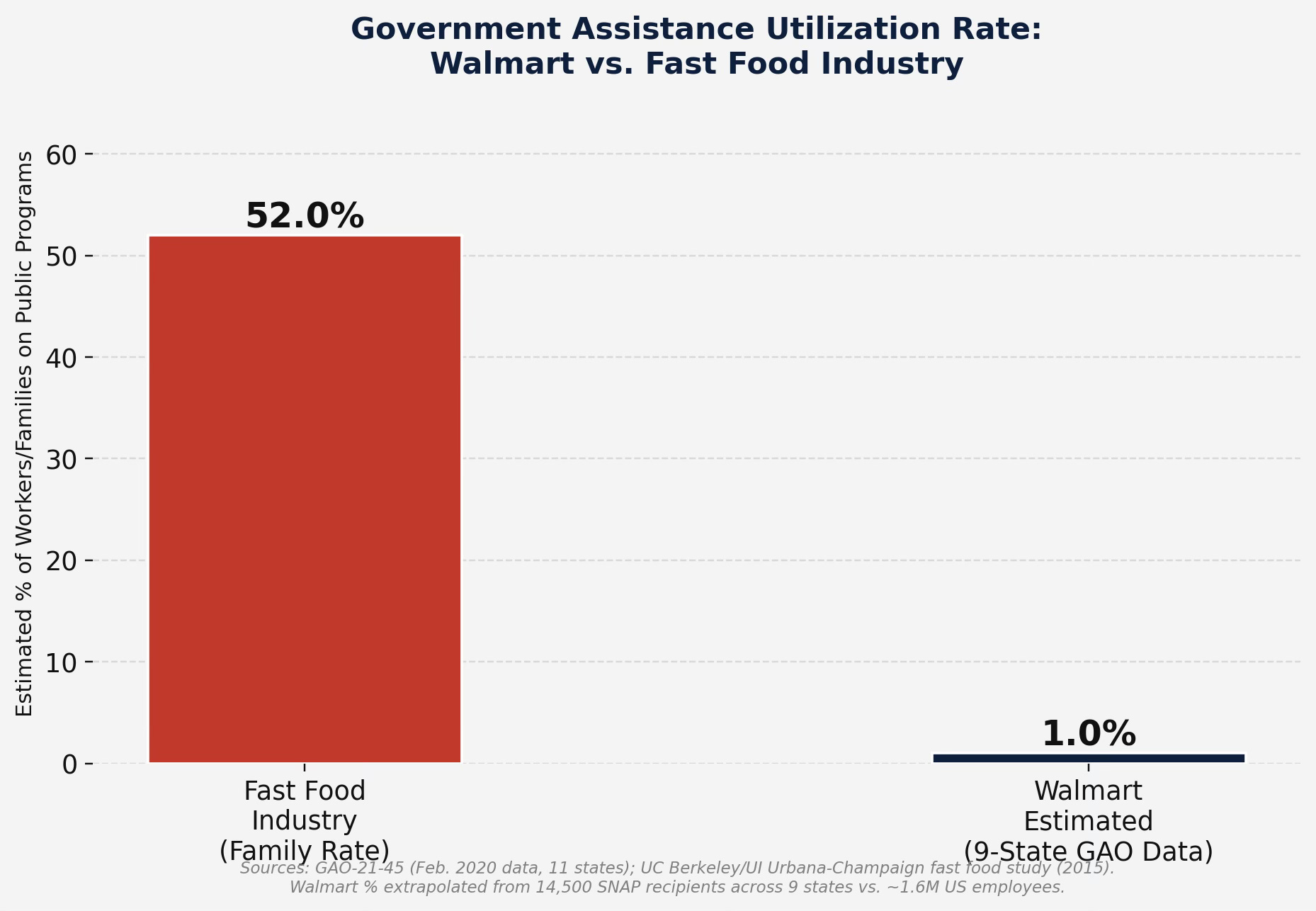
The University of California Berkeley and University of Illinois found that more than 52 percent of fast food workers’ families rely on a public assistance program. Walmart absorbs the majority of the political criticism despite a proportional rate more than fifty times lower than fast food.
SECTION V: THE QUESTION NOBODY ASKED — THE DATA THAT COULD END THIS DEBATE
Buried inside the standard onboarding paperwork at Walmart and Sam’s Club is a federal form that answers the question every critic and every defender of the company has spent five years arguing about without resolving. It is called IRS Form 8850, the Pre-Screening Notice and Certification Request for the Work Opportunity Tax Credit.
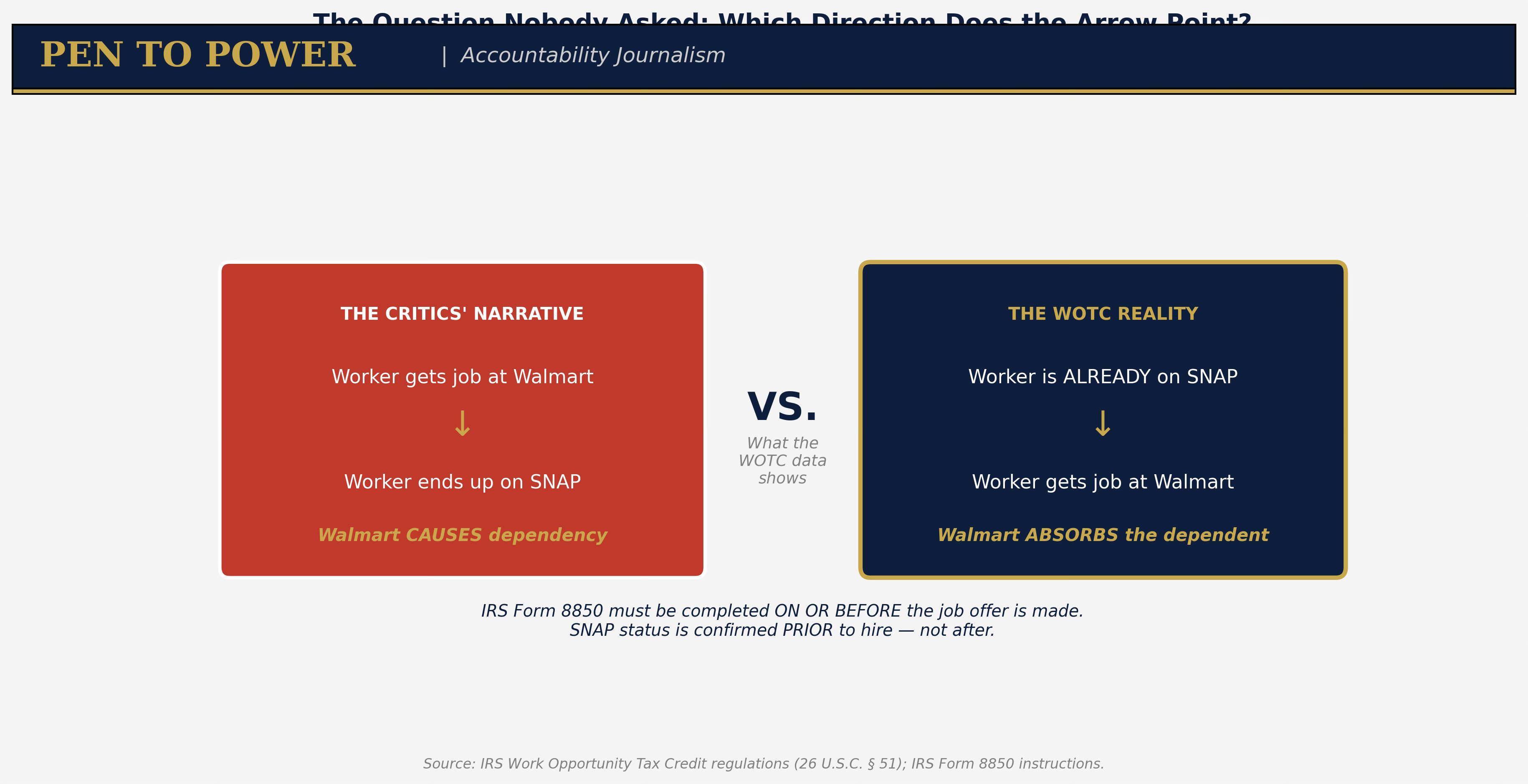
The IRS requires that Form 8850 be completed on or before the day that an offer of employment is made. The form asks whether the applicant is currently receiving SNAP benefits, has received them for at least six consecutive months in the prior fifteen months, or is currently enrolled in Medicaid. The applicant answers before the job offer is finalized. The state workforce agency certifies the answer. The employer then claims a federal tax credit based on that certification.
The worker is already certified as a SNAP recipient before the job offer is made. That is not a technicality. That is the entire question.
For each employee hired who is already enrolled in SNAP or other qualifying public assistance, Walmart can collect federal tax credits of up to $9,600 per hire through the Work Opportunity Tax Credit program. There is no cap on the number of qualifying hires and therefore no ceiling on the total credits that can be claimed.
The WOTC questionnaire is part of Walmart’s onboarding paperwork. Walmart files these forms. The state agencies certify them. The data by employer, hire by hire, exists in the records of every state workforce agency in America.
The scale of this program nationally is staggering. In 2022, the SNAP category produced 1,563,752 WOTC certifications, representing 60.86 percent of all credits issued that year. In 2023, SNAP certifications reached 1,289,001, accounting for 64.82 percent of the total. Across those two years alone, more than 2.85 million Americans were hired by employers who confirmed at the point of hire that those workers were already on food stamps before they walked through the door.
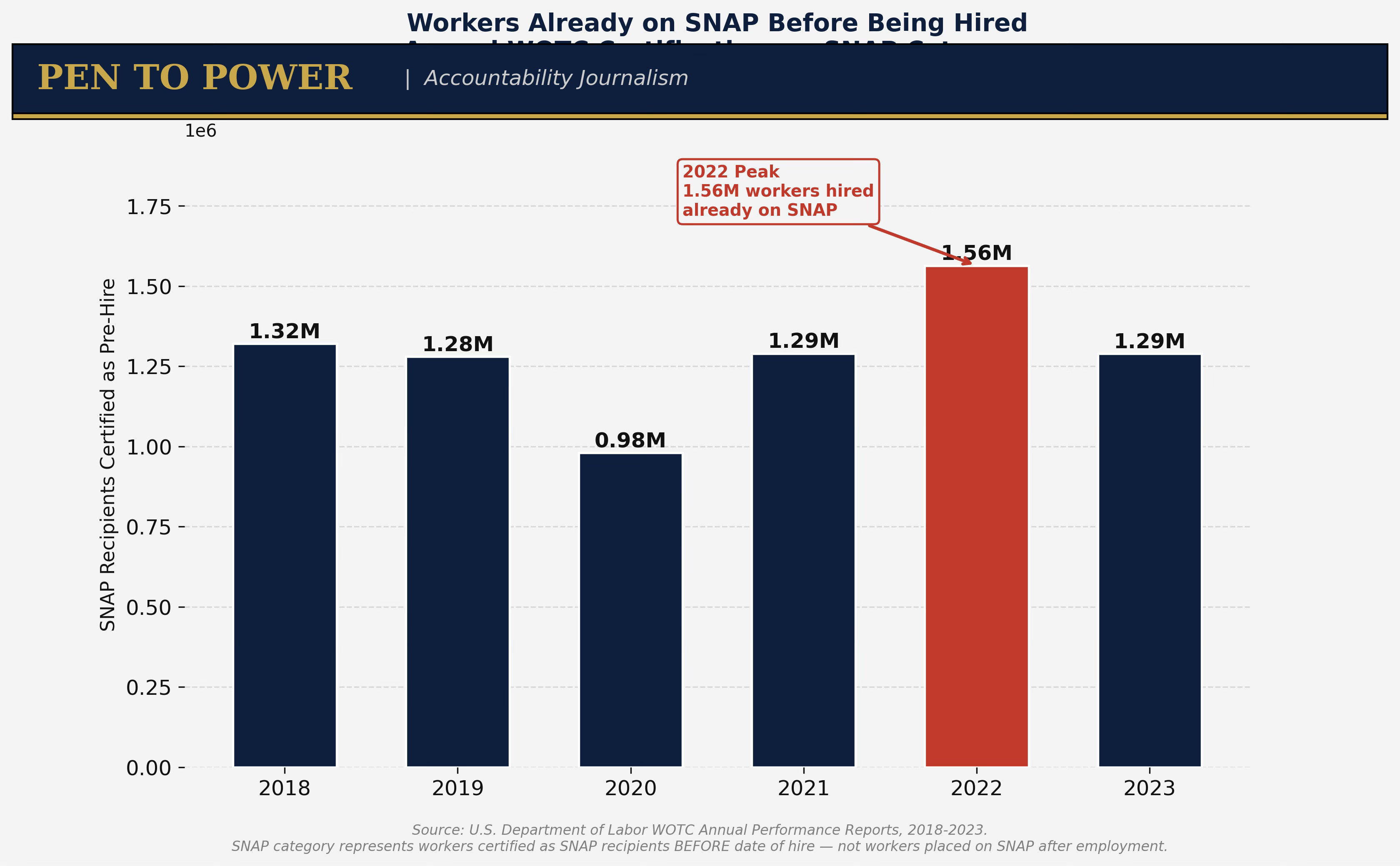
Read that again carefully. More than 2.85 million people, in two years, certified as SNAP recipients before their first day of work. Not after. Before. That is what the WOTC data documents: employers, including Walmart, actively hiring people who are already dependent on government assistance and filing the federal paperwork to prove it.
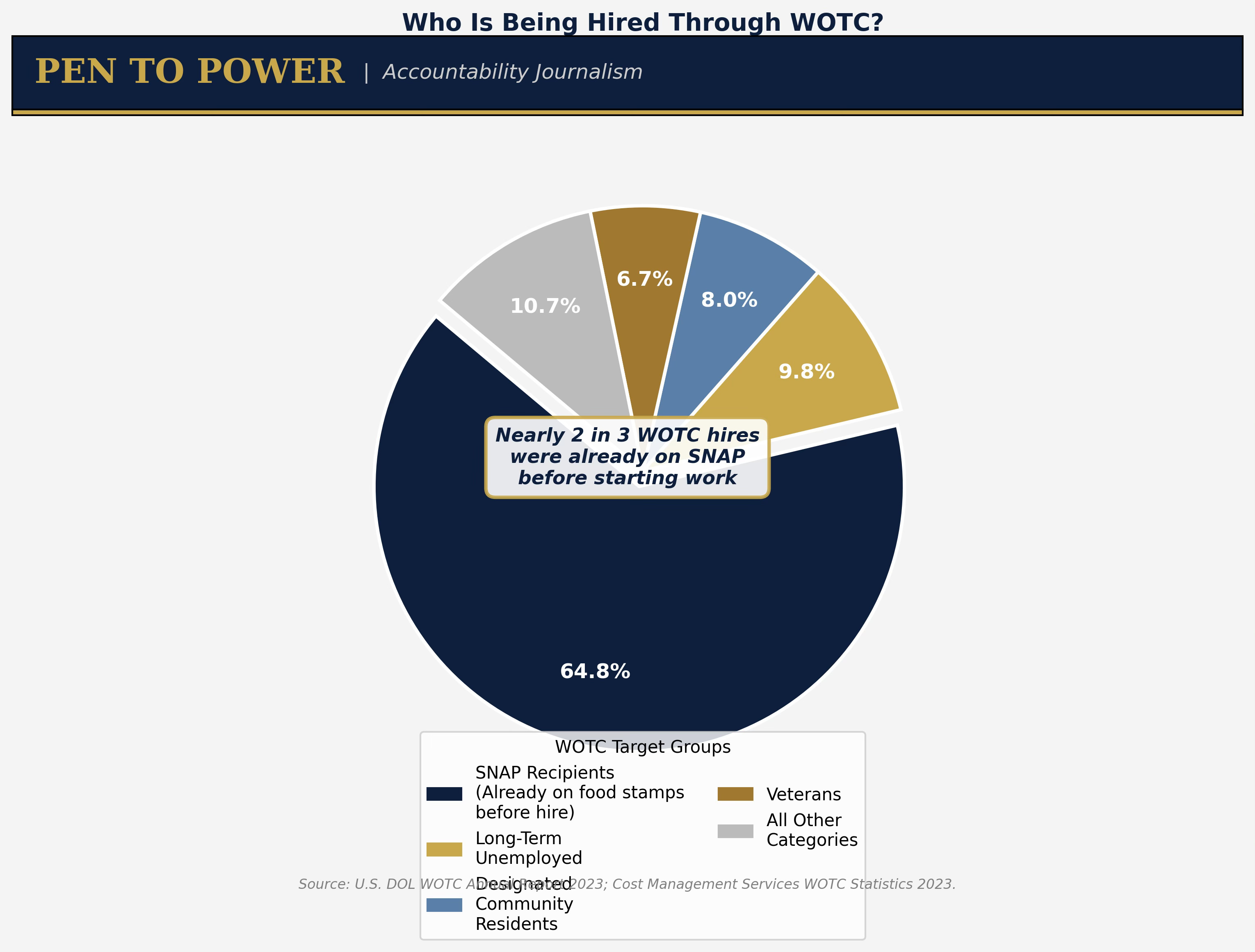
Walmart’s critics built their entire case on a methodology that cannot distinguish between cause and effect. The tool that could make that distinction has been sitting, unused, in the one place everyone forgot to look.
The argument that Walmart puts people on SNAP rests entirely on the assumption that the causal arrow points from employment to dependency. The WOTC enrollment sequence runs in the opposite direction: the worker is already certified as a SNAP recipient before the job offer is made. A company that consistently hires workers already enrolled in public assistance and then moves them up a documented wage ladder, paying tuition, matching retirement contributions, and issuing 348,000 promotions to a single decade-long cohort, is not manufacturing welfare recipients. It is absorbing them from the rolls and giving them a reason to eventually leave.
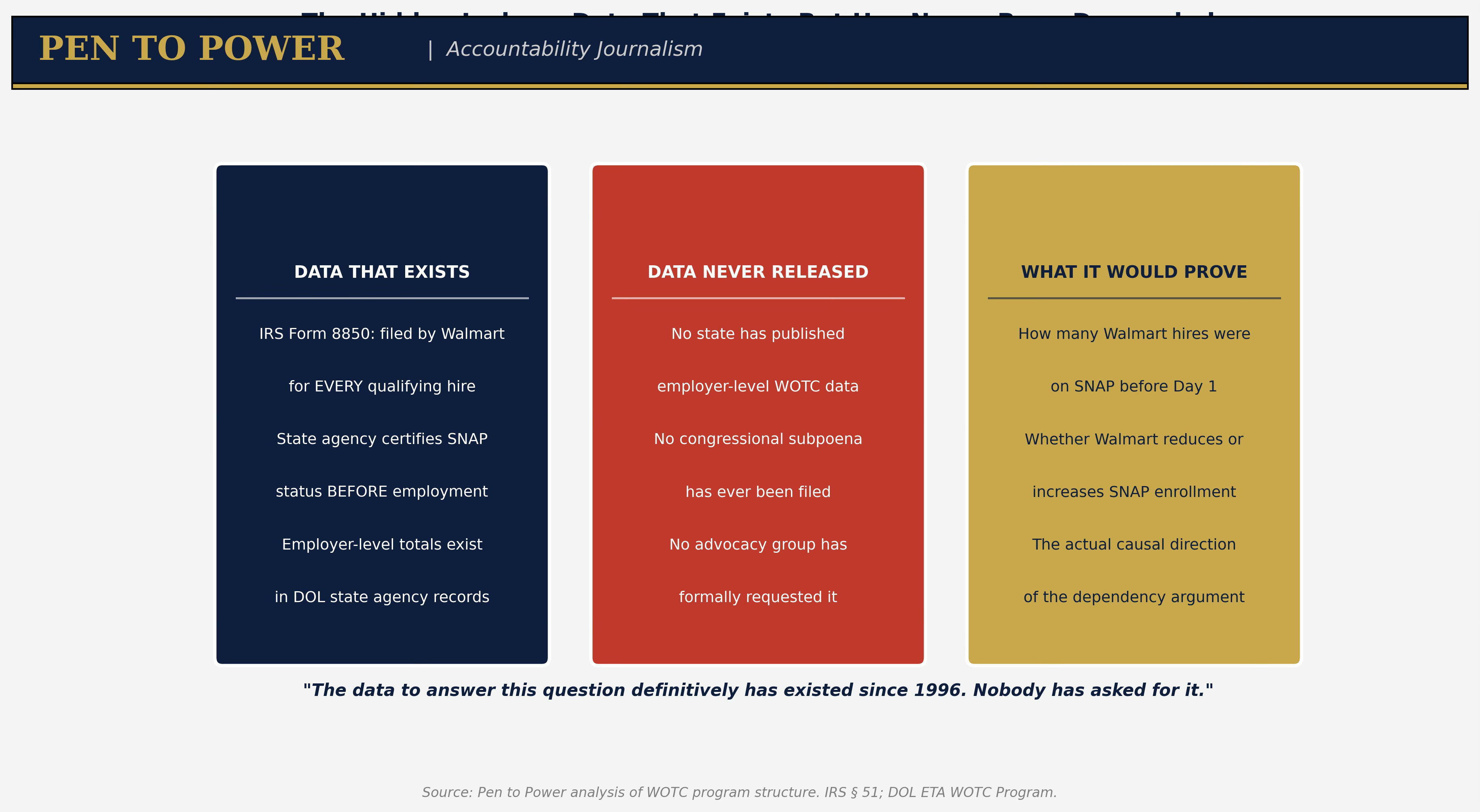
The data to prove that conclusively has existed since 1996. Senator Bernie Sanders commissioned the GAO report. That report captured a snapshot of who was on assistance at a single point in time. It did not ask whether those workers were on assistance before Walmart hired them or because of it. The GAO acknowledged explicitly that its methodology could not answer that question. The Work Opportunity Tax Credit program can. Or rather, it could, if anyone demanded the data. No journalist has. No senator has. No advocacy organization has filed a single formal request with any state workforce agency to obtain employer-level WOTC certification data. That silence is not an oversight. It is a choice. And it is the choice that has allowed a half-built argument to function as a finished indictment.
SECTION VI: THE STEPLADDER — WHAT THE FINISH LINE LOOKS LIKE
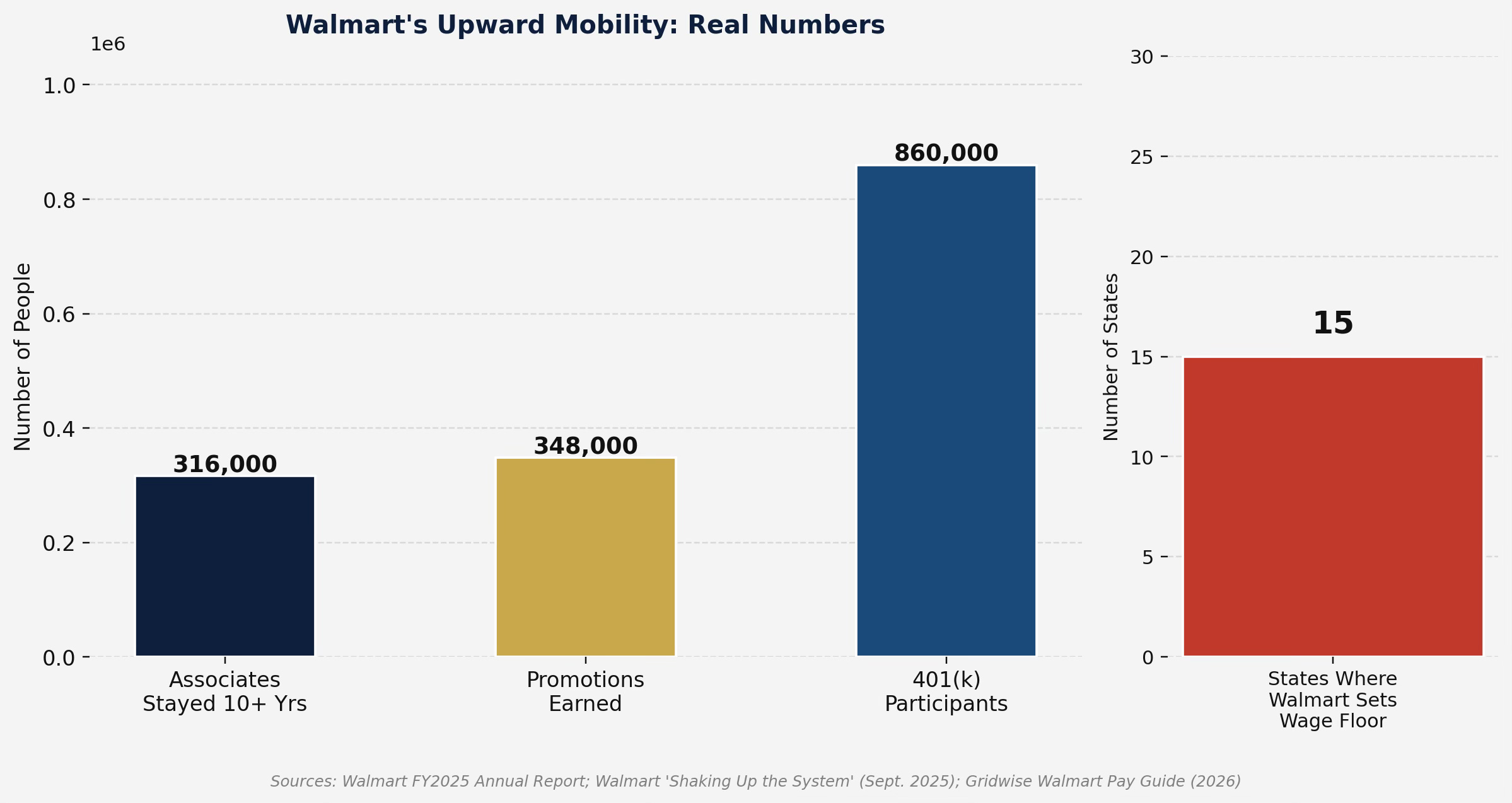
The most consequential data point in this story is not a wage figure or a SNAP enrollment count. It is a mobility number. More than 316,000 associates who were hourly workers at Walmart in 2015 accumulated more than 348,000 promotions over the following decade. One-fifth of Walmart’s current U.S. workforce was an hourly associate in 2015. They stayed. They moved up.
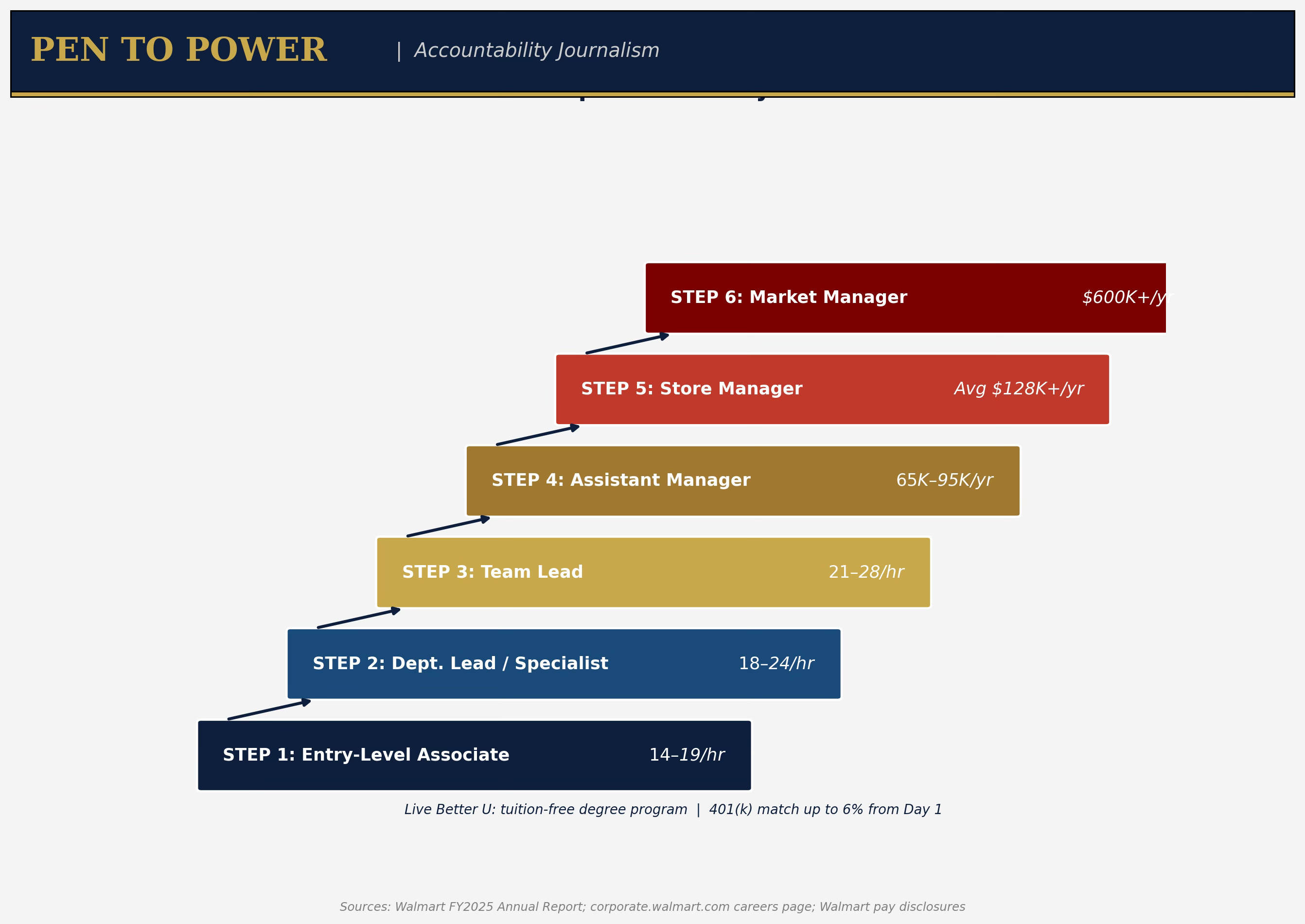
The wage ladder at Walmart is not hypothetical. Entry-level associates begin at $14 to $19 per hour. Department leads earn $18 to $24. Team leads reach $21 to $28. Assistant managers earn $65,000 to $95,000 annually. Store managers average more than $128,000 per year. Market managers earn more than $600,000 in some cases. In fifteen states where no state minimum wage law exceeds the federal floor of $7.25, Walmart’s $14 company minimum is the single most meaningful wage protection available to unskilled entry-level workers.
SECTION VII: BENEFITS — WHAT THE NARRATIVE IGNORES
Walmart’s 401(k) plan is available to all U.S. associates beginning on the first day of employment. The company matches contributions up to 6 percent of pay for full-time and part-time hourly associates who complete 1,000 hours in their first year. As of fiscal year-end 2025, more than 860,000 associates held retirement savings in the plan, and Walmart’s company match totaled $1.82 billion for the year. Medical coverage for eligible associates begins at $36.10 per pay period. The Live Better U tuition-free degree program represents a direct investment in associates’ long-term earning power. Total Walmart investment in wages, benefits, and training has exceeded $5 billion since 2020.
CONCLUSION: THE FINISH LINE
The accusation that Walmart creates welfare dependency rests on a single, decontextualized data set from 2020 that the GAO itself described as not nationally generalizable. It treats raw headcount as a percentage without acknowledging that less than 1 percent of Walmart’s U.S. workforce appears in that data. It ignores the fast food industry, whose workforce carries a government assistance burden more than fifty times larger on a proportional basis. It ignores a decade of documented wage increases that outpaced the retail sector. It ignores 348,000 promotions, 860,000 retirement savers, a tuition-free degree program, $1.82 billion in 401(k) matching contributions in a single fiscal year, and a federal program that documents, hire by hire, that millions of workers were already on SNAP before their first day on the job.
The data to answer the real question: not who is on SNAP while working at Walmart, but who was on SNAP before Walmart hired them, exists. It has always existed. The WOTC system captured it at the point of hire. Nobody has demanded its release. The debate has continued without it because the argument was never really about the data. It was about the narrative.
Walmart did not build a machine that creates welfare recipients. It built a stepladder. The finish line for a worker who enters at $14 per hour is not the poverty line. The data, all of it, supports that argument more convincingly than it supports the alternative. The question that remains unasked is the one that would prove it beyond dispute.
The debate has continued without the data because the argument was never really about the data. It was about the narrative.
Moon,
SOURCES & FOOTNOTES
[1] Walmart Inc. FY2025 Annual Report (Form 10-K), SEC filing, fiscal year ended January 31, 2025. stock.walmart.com
[2] U.S. Government Accountability Office. GAO-21-45, ‘Federal Social Safety Net Programs.’ October 2020. gao.gov/products/gao-21-45
[3] U.S. Bureau of Labor Statistics. ‘A Look at Jobs Paying Less Than $15.00 Per Hour.’ Spotlight on Statistics, 2024. bls.gov/spotlight/2024
[4] U.S. Bureau of Labor Statistics. Occupational Employment and Wage Statistics, May 2024. bls.gov/oes
[5] U.S. Bureau of Labor Statistics. ‘Characteristics of Minimum Wage Workers, 2024.’ bls.gov/opub/reports/minimum-wage/2024
[6] Internal Revenue Service. ‘Work Opportunity Tax Credit.’ 26 U.S.C. § 51. IRS Form 8850. irs.gov/businesses/small-businesses-self-employed/work-opportunity-tax-credit
[7] U.S. Department of Labor, ETA. WOTC Annual Performance Reports, 2018-2023. dol.gov/agencies/eta/wotc/performance
[8] Cost Management Services. ‘WOTC Statistics 2022 and 2023.’ cmswotc.com
[9] Walmart Corporate. ‘Shaking Up the System.’ September 25, 2025. corporate.walmart.com
[10] Walmart Corporate. ‘How Much Do Walmart Associates Make?’ corporate.walmart.com/askwalmart
[11] Bivens, J. et al. ‘Fast Food, Poverty Wages.’ UC Berkeley Labor Center / University of Illinois, 2013; updated 2015.
[12] Gridwise. ‘Walmart Pay Guide 2026.’ gridwise.io/blog/walmart-pay
Pen to Power | pentopowermoon@gmail.com |
Moon Geezer | May 2026