IRAN WAR.....OVER?
Trump and Iran say it is, Moon digs in

Non-Partisan. Adversarial. Always.
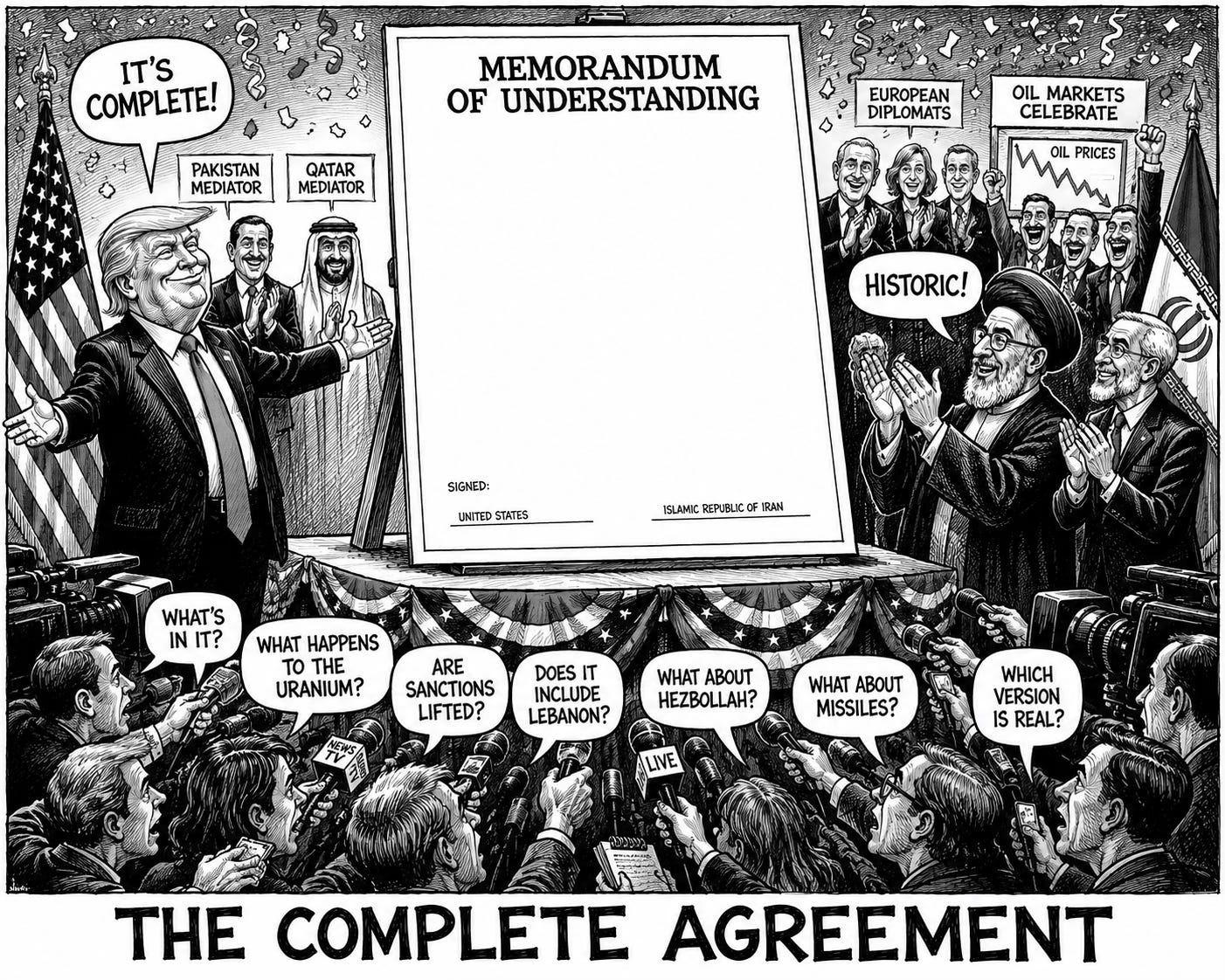
Trump Declares U.S.-Iran Deal ‘Complete’ …. as Both Sides Agree to End War, Reopen Strait
But the Actual Text Remains Secret
Both governments claim a 14-point memorandum of understanding ends the war and reopens the Strait of Hormuz. No authenticated text has been published. What is public are government statements, leaked summaries, and competing accounts that contradict each other on the core terms.
JUNE 14, 2026 -- PEN TO POWER -- MOON GEEZER
President Donald Trump declared Sunday evening that the United States and Iran have reached a deal to end their months-long war, posting on Truth Social that the agreement is ‘now complete’ and simultaneously ordering the removal of the U.S. naval blockade of Iranian port traffic and the reopening of the Strait of Hormuz. ‘Ships of the World, start your engines. Let the oil flow!’ Trump wrote.1
Pakistani Prime Minister Shehbaz Sharif, one of the principal mediating parties alongside Qatar, announced that ‘both sides have declared the immediate and permanent termination of military operations on all fronts, including in Lebanon.’2 Iranian Deputy Foreign Minister Kazem Gharibabadi confirmed on state media that a deal had been reached following 14 hours of talks with Qatari mediators.3 A formal signing ceremony is set for Friday, June 19, in Switzerland.
What neither government has done is release the text. As of Sunday night, no authenticated version of the memorandum of understanding has been made public. What is circulating are government statements, media-reported summaries from negotiators, and documents published by Iranian state-linked outlets whose status -- draft, final, or partial -- remains unverified.4
‘The Deal with the Islamic Republic of Iran is now complete. Congratulations to all!’ -- President Donald Trump, Truth Social, June 14, 2026
WHAT THE GOVERNMENTS ARE SAYING
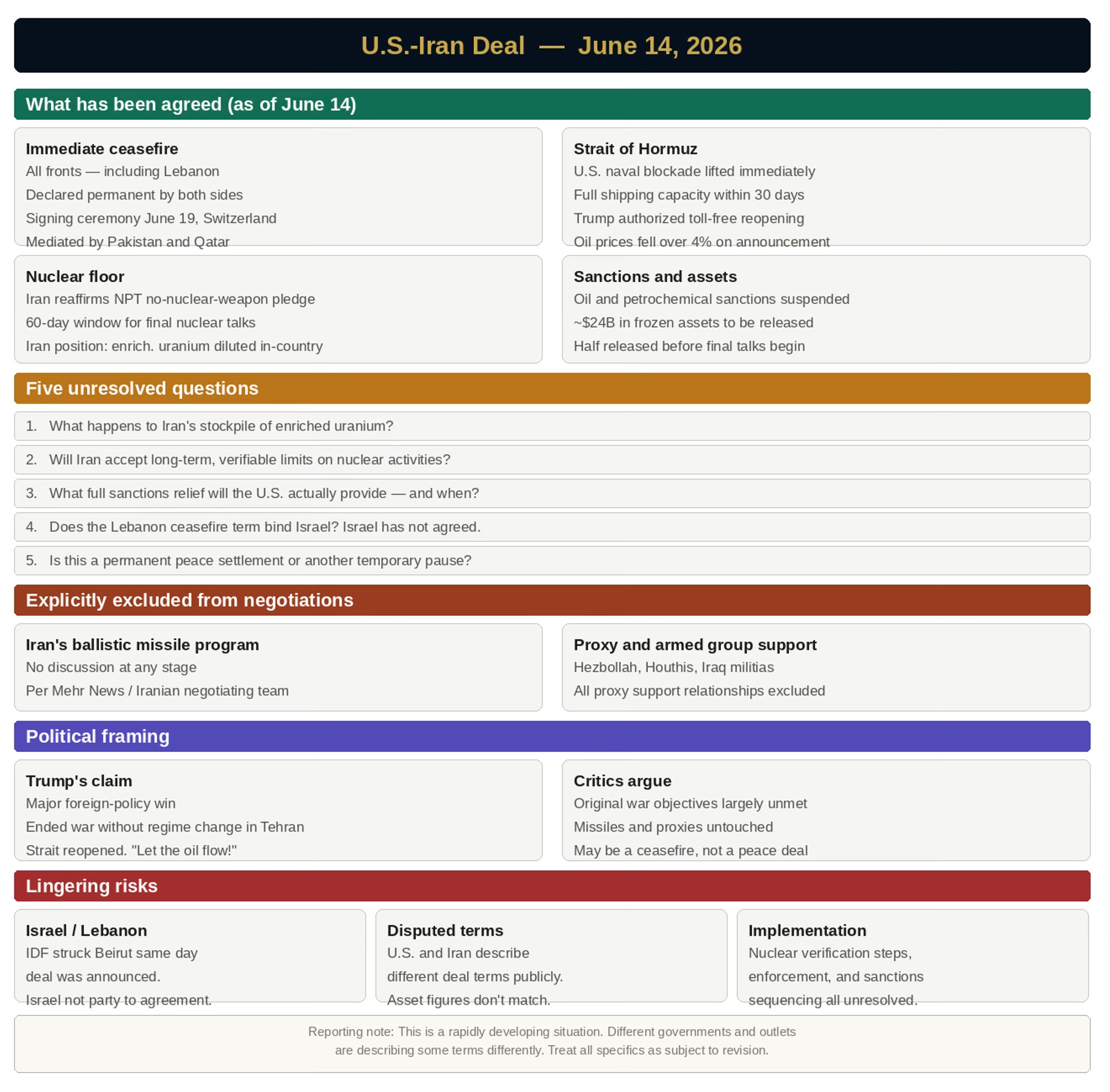
Trump authorized the lifting of the naval blockade and the reopening of the Strait of Hormuz immediately upon his announcement, an action that is concrete and observable. Beyond that, the specific terms of the memorandum come entirely from official statements and from documents published by parties to the negotiation -- not from an independent, released text.
Iranian Foreign Minister Abbas Araghchi stated that the deal includes an end to hostilities across all fronts, including Lebanon, and an agreement not to initiate war or use force. He said frozen Iranian assets will be released upon the MOU’s signing and that the nuclear issue will be addressed in a second phase of negotiations, with Iran’s position being that its enriched uranium should be diluted inside the country rather than exported.5
A senior Trump administration official told Reuters that under the emerging deal, Iran’s nuclear program would be dismantled, all nuclear materials destroyed and removed, and Iran would not be able to continue funding proxy groups in the region. The official described the deal as ‘performance-based,’ with no frozen assets released until Iran fulfills its commitments.6 That account conflicts directly with what Iranian officials have described, and it conflicts with the Mehr News draft, which shows assets released before final negotiations begin.
THE DOCUMENT PROBLEM
The Guardian reported Sunday that the actual text of the agreement has not been published, and that key provisions are being described differently by Washington, Tehran, Pakistan, and Israel.7 This is not a minor discrepancy. The parties cannot agree on whether Lebanon is included in the ceasefire, when and whether sanctions are lifted, what happens to Iran’s enriched uranium, and whether the Strait of Hormuz reopens immediately or after implementation steps are completed. These are questions that a released text would settle.
Iran’s semi-official Mehr News Agency published what it described as a 14-point draft memorandum. Those provisions include an immediate and permanent ceasefire on all fronts including Lebanon, a U.S. commitment to lift the naval blockade within 30 days of signing, suspension of sanctions on Iranian oil and petrochemicals, release of approximately $24 billion in frozen assets, and a 60-day window for final negotiations on nuclear issues and remaining sanctions.8 The Mehr News document has not been independently authenticated as the final agreed text.
Reuters, citing an Iranian official, reported the frozen asset figure as $25 billion. Bloomberg’s version of the document contained no such stipulation.9 Trump posted Friday that the leaked Iranian terms ‘have NOTHING to do with the terms that were agreed to, in writing’ -- then on Sunday declared the deal complete without releasing the text that would resolve the dispute.10
No authenticated text has been published. What is circulating are government statements, negotiator summaries, and documents from Iranian state-linked outlets whose status -- draft, final, or partial -- has not been verified.
WHAT WAS LEFT OUT
The Mehr News version of the draft states explicitly that Iran’s ballistic missile program and its support for regional armed groups including Hezbollah will not be included in negotiations at any stage.11 That is consistent with what Iranian negotiators have said publicly throughout the talks.
The senior Trump administration official’s account to Reuters contradicts this directly, claiming the deal would prevent Iran from continuing to fund proxy groups. No mechanism for enforcing or verifying either claim has been described by either government. The final agreement, according to both sides, is to be limited to nuclear enrichment activities, sanctions relief, and Iran’s war reconstruction -- leaving the missile program and proxy network as unresolved questions deferred beyond the 60-day window.12
ISRAEL: SIDELINED AND STRIKING
Israel was not a party to Sunday’s agreement. Throughout the day, as the deal neared finalization, the Israel Defense Forces conducted strikes on Hezbollah targets in Beirut’s southern Dahiyeh district, killing three people and wounding sixteen according to Lebanon’s Health Ministry.13 IDF officials cited Hezbollah fire against Israeli civilians and soldiers in southern Lebanon as the basis for the action.
Trump condemned the Israeli strikes as threatening to derail the agreement, posting on social media: ‘We are very close to a Deal that will bring peace to the region, including to Lebanon. Let’s not blow it!’ He later told Fox News he still expected the deal to be signed within hours and planned to ask Tehran not to retaliate.14
Iranian Parliamentary Speaker Mohammad Bagher Qalibaf responded by warning that ‘the Zionists’ incursion into Dahiyeh has once again shown that America either lacks the will to fulfill its commitments or the ability to do so.’15 The deal was ultimately announced despite those strikes, but whether Israel considers itself bound by the Lebanon ceasefire language -- language Israel never agreed to -- remains unanswered.
Israel’s government has been described by multiple outlets as deeply disappointed with the deal in its current form, having been sidelined throughout negotiations led by Pakistan and Qatar.16 The two items Israel identified as core objectives entering the conflict -- dismantlement of Iran’s ballistic missile program and termination of Iranian support for Hezbollah -- do not appear in any version of the memorandum that has been publicly described.
BACKGROUND
The 2026 Iran war began February 28 when the United States and Israel launched joint airstrikes on Iran targeting military, government, and infrastructure sites, including the assassination of Supreme Leader Ali Khamenei. Iran responded with missile and drone strikes against Israel and U.S. regional assets. The conflict had been preceded by the collapse of indirect nuclear negotiations in February 2026 and by months of escalating Israeli operations against Iranian proxy infrastructure across Lebanon, Syria, Iraq, and Yemen dating to the aftermath of October 7, 2023.17
The conflict produced more than 7,500 deaths, the majority in Lebanon and Iran, and severely disrupted global oil markets through Iranian interference with Strait of Hormuz traffic. The U.S. responded by imposing a naval blockade on Iranian port traffic, the removal of which became a central Iranian demand in negotiations.18
Qatar and Pakistan served as the primary mediating parties. Axios and other outlets have described the current framework as a preliminary agreement rather than a detailed peace treaty, with the most consequential nuclear questions deferred to later talks.19 A prior ceasefire between Iran and Israel from June 2025, the product of the Twelve-Day War, had expired in February 2026 and was followed by the resumption of hostilities. An April 2026 ceasefire between Israel and Lebanon brokered by the United States was extended multiple times before breaking down again in early June.20
WHAT COMES NEXT
The 60-day negotiating window described in every account of the memorandum will govern final talks on nuclear activities, sanctions, and reconstruction. Those talks will need to resolve not only the substance of those issues but also the publicly divergent U.S. and Iranian accounts of what the MOU commits each side to -- a gap that neither government has acknowledged.
European governments including the United Kingdom, Germany, France, and Italy welcomed the deal Sunday and said they stand ready to lift sanctions on Iran in exchange for steps on the nuclear program, affirming that Iran ‘must never acquire a nuclear weapon.’21 The signing ceremony in Switzerland on June 19 will be the next observable test of whether an agreement actually exists in the form both sides are describing.
The clearest indicator of the document problem is what analysts are still arguing about as of Sunday night: whether Lebanon is included in the ceasefire, exactly which sanctions are lifted and when, what happens to Iran’s enriched uranium, and whether the Strait reopens immediately or after implementation. A released text would settle all of these questions. None of them are settled.
Moon Geezer | Pen to Power | pentopowermoon@gmail.com | Non-Partisan. Adversarial. Always.
ENDNOTES
1. Donald Trump, Truth Social post, June 14, 2026. https://www.cbsnews.com/news/us-iran-deal-reached-trump-strait-of-hormuz/
2. Pakistan PM Sharif statement on X, reported by CNBC, June 14, 2026. https://www.cnbc.com/2026/06/14/us-iran-war-peace-deal.html
3. Iranian Deputy FM Gharibabadi confirmation, NBC News, June 14, 2026. https://www.nbcnews.com/news/us-news/deal-reached-united-states-iran-war-rcna350039
4. The Guardian, June 14, 2026: actual text not published; key provisions described differently by Washington, Tehran, Pakistan, and Israel.
https://www.theguardian.com
5. Araghchi remarks on enrichment and asset release, Al Jazeera, June 14, 2026. https://www.aljazeera.com/news/2026/6/14/will-the-us-iran-deal-be-signed-on-sunday-what-we-know-so-far
6. Senior Trump administration official on deal terms, Reuters via Jerusalem Post, June 2026. https://www.jpost.com/middle-east/iran-news/article-899213
7. The Guardian, June 14, 2026: text not published; terms described differently by all parties.
https://www.theguardian.com
8. Mehr News Agency 14-point draft provisions, reported by Il Sole 24 Ore and i24NEWS. https://en.ilsole24ore.com/art/the-14-point-us-iran-agreement-according-to-tehran-AINbFTdD
9. Asset figure discrepancy between Reuters and Bloomberg, Fortune, June 14, 2026. https://fortune.com/2026/06/14/iran-ceasefire-terms-mou-versions-us-deal-sanctions-hormuz-blockade-nuclear-program-frozen-assets/
10. Trump disputes Iranian account of terms, CNBC, June 12, 2026. https://www.cnbc.com/2026/06/12/iran-us-peace-memo-strait-hormuz-oil-sanctions.html
11. Missile program and proxy exclusion, Mehr News, reported by Jerusalem Post. https://www.jpost.com/middle-east/iran-news/article-899213
12. Final agreement scope limited to enrichment, sanctions, and reconstruction, NBC News, June 14, 2026. https://www.nbcnews.com/news/us-news/deal-reached-united-states-iran-war-rcna350039
13. Israeli Beirut strikes and casualties, ABC News live updates, June 14, 2026. https://abcnews.com/International/live-updates/iran-live-updates-israel-iran-trade-strikes-trump/?id=133674243
14. Trump response to Israeli strikes and Fox News comments, PBS NewsHour, June 14, 2026. https://www.pbs.org/newshour/world/trump-warns-israel-and-iran-not-to-blow-it-after-new-strikes-threaten-emerging-ceasefire-deal
15. Qalibaf statement on X regarding Dahiyeh strikes, CNBC, June 14, 2026. https://www.cnbc.com/amp/2026/06/14/iran-deal-teeters-israel-strikes-lebanon.html
16. Israel sidelined in negotiations, Philadelphia Inquirer, June 14, 2026. https://www.inquirer.com/news/nation-world/iran-us-israel-ceasefire-deal-sign-lebanon-hezbollah-nuclear-20260614.html
17. 2026 Iran war background and Khamenei assassination, Wikipedia: Reactions to the 2026 Iran war.https://en.wikipedia.org/wiki/Reactions_to_the_2026_Iran_war
18. Death toll and Strait disruption, NBC News / ms.now, June 14, 2026. https://www.ms.now/news/u-s-and-iran-finally-reach-deal-trump-says
19. Framework agreement framing, Axios, June 2026.
https://www.axios.com
20. Ceasefire history, Wikipedia: 2026 Israel-Lebanon ceasefire. https://en.wikipedia.org/wiki/2026_Israel%E2%80%93Lebanon_ceasefire
21. European nations joint statement, CNBC and NPR, June 14, 2026. https://www.cnbc.com/2026/06/14/us-iran-war-peace-deal.html
It’s a fantastic soccer ⚽️ deal! Kills two birds with one stone ! You get 60 days to rearm and 60 days to watch soccer!
We got a Peace Deal just in time for FOX Sports 1 coverage of Iran vs New Zealand tonight at 6pm Pacific from Los Angeles, California USA 🇺🇸